
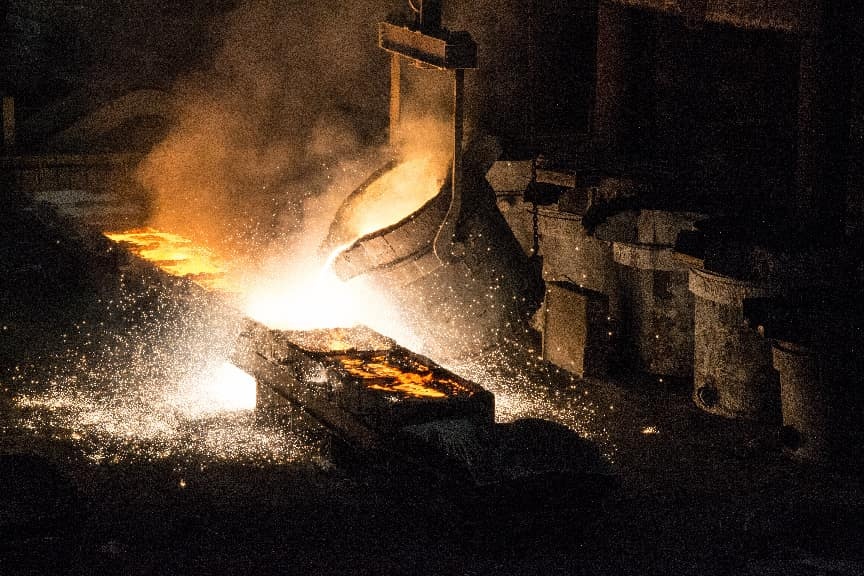
Sand Casting — The Oldest and Most Widely Used Casting Method
The core of sand casting is a sand mold — a cavity formed by compacting molding sand (quartz sand + clay/resin binder) around a pattern (wood or aluminum) to create the external shape of the casting. The wood or aluminum pattern itself is not the mold — it is the “mold of the mold” — used to repeatedly press out identical cavities in hundreds of sand molds. After pouring, the sand mold is broken to remove the casting — the sand can be recycled and reused, but the sand mold is disposable. Sand casting is suitable for single-piece and small-batch production — from marine engine blocks weighing tens of tons down to mechanical parts weighing a few kilograms. Patterns are made of wood (pine, birch) or aluminum alloy — inexpensive but with relatively low precision (typical tolerance ±1-3 mm).
The production of sand casting patterns has changed greatly from centuries ago. Traditionally, hand-made wooden patterns were used — carpenters sawed, planed, and assembled wood into the “reverse shape” of the casting according to drawings. Now, for sand casting with somewhat larger batch sizes, patterns have switched to aluminum alloy CNC machining — using CNC to mill the shape of the pattern plate and the gating system from a solid aluminum plate, which is much more precise than hand-made wooden patterns (±0.2-0.5 mm) and more wear-resistant. A set of aluminum alloy sand casting patterns can withstand several thousand sand-compaction cycles — greatly reducing the pattern cost per piece.
The biggest limitation of sand casting is surface roughness — Ra values typically in the range of 12.5-50 μm. The cast products have sand grain marks on the surface — requiring subsequent machining to achieve a fine surface. This is why sand casting is generally used for rough blanks — for example, the outer surface of engine cylinder blocks is later precision-milled on a machining center. For more comparisons of casting processes, refer to the comparison of die casting and casting in automotive die casting molds.
Metal Mold Casting — Metal Molds That Can Be Reused
Metal mold casting (also called permanent mold casting) does not use sand but uses metal (cast iron or cast steel) to make the mold — which can be reused hundreds to tens of thousands of times. During pouring, the molten metal flows into the metal cavity by gravity — like sand casting, it is gravity pouring, but the mold is not disposable. Advantages of metal mold casting: surface roughness is better than sand casting (Ra 6.3-12.5 μm), dimensional accuracy is higher (±0.3-0.5 mm), and cooling speed is faster (metal molds conduct heat faster than sand molds), resulting in finer grains and higher strength in the casting. The disadvantage is the high mold cost — a set of cast iron metal molds may cost tens of thousands to hundreds of thousands of yuan — not suitable for small batches.
The mold structure of metal mold casting is much more complex than that of sand casting. Because metal molds cannot “breathe” like sand molds — gases in the molten metal need to be discharged through dedicated vent grooves during pouring. Also, metal molds need to be preheated (usually 200-300°C) — otherwise, a cold mold contacting high-temperature molten metal will produce thermal shock and cause the mold to crack. Draft angles are also required — metal molds do not have the “yielding” property of sand molds — if the mold does not have a draft angle, the casting will be stuck in the mold and cannot be removed when it contracts.
Metal mold casting is particularly widely used for aluminum alloy products (such as aluminum wheels and aluminum cylinder heads) — because the pouring temperature of aluminum is lower than that of cast iron (about 700°C vs 1300°C) — the mold thermal load is low and the service life is long. A set of cast iron metal molds for pouring aluminum alloy can be used several thousand to tens of thousands of times — cost-effective. But it cannot be used for pouring cast iron — the 1300°C high temperature of molten iron plus the erosion of the iron mold by molten iron — the mold life drops sharply, possibly only a few hundred times.
Investment Casting (Lost Wax Method) — The Ceiling of Precision
The mold for investment casting is a set of aluminum or steel molds used to inject wax patterns — first make a wax pattern identical to the final product, dip it in slurry and stucco repeatedly to form a ceramic shell, heat it to melt out the wax, and then pour molten metal into the ceramic shell. The core advantage of this process is extremely high precision (±0.1-0.3 mm) and the ability to make arbitrarily complex shapes — parts at the complexity level of turbine blades, medical devices, and jewelry can only be made by the lost wax method. But the cost is also the highest — the cost of one casting is 5-20 times that of sand casting.
The mold for investment casting has two layers: the first layer is the injection mold for making wax patterns — usually aluminum alloy or steel, with high precision requirements — because the precision of the wax pattern determines the precision of the final casting. The structure of this layer of mold is similar to a small injection mold — with a parting surface and an ejection mechanism. The second layer is the ceramic shell — it is a “disposable” mold — it must be broken to remove the casting after pouring the metal. Therefore, the efficiency of investment casting is not high — after a wax pattern is made, it must be coated to form a shell, dewaxed, poured, cooled, and shell-broken — the whole process takes at least two or three days and at most a week — completely unsuitable for scenarios pursuing efficiency in large-volume production.
But what makes investment casting irreplaceable is its ability to make parts with “internal cavities too complex to be directly formed by molds.” For example, hollow turbine blades for gas turbines — the blades have winding cooling air passages inside — such structures can only be made by 3D printing or the lost wax method. Wax patterns can be made extremely fine — and then the ceramic shell perfectly replicates all the details. This is the fundamental reason why investment casting remains enduring in the aircraft engine and medical implant markets.
Lost Foam Casting — A Modern Casting Process Using Foam Instead of Wax
Lost foam casting (EPS mold) first uses a set of aluminum molds to make an EPS foam pattern identical to the product from expanded polystyrene (EPS) foam — the foam pattern is buried in dry sand — during pouring, the high-temperature molten metal gasifies the foam and takes over the space occupied by the foam — after the metal cools, the casting is obtained. Advantages: the foam mold has fast forming speed (one foaming machine can produce one foam pattern in a few minutes), easy demolding (foam does not stick to the mold), and no draft angle required (foam can be made into negative-angle structures). Disadvantages: foam gasification emits organic gases that require environmental treatment, and carbon slag defects may occur on the casting surface.
The mold for lost foam casting — is the aluminum mold used to make foam patterns. This set of molds consists of upper and lower halves, with heating and cooling systems. EPS pre-expanded beads are injected into the cavity and steam is passed in to heat the beads so they expand and fuse into an integral foam pattern. One set of lost foam casting molds can produce hundreds of thousands of foam patterns — corresponding to hundreds of thousands of castings. This efficiency is much higher than sand casting — but it is only suitable for castings with surface quality requirements one grade lower (such as automotive brake discs, exhaust pipes, pump housings, etc.).
Lost foam casting has developed rapidly in China in recent years — because the demand for it in automotive parts and construction machinery parts is growing. Compared with sand casting, lost foam casting eliminates the core-making and mold-closing processes, has high automation efficiency, and is competitive in per-piece cost. However, if the foam gasification during pouring is not well controlled — incomplete foam gasification will leave carbon defects in the casting — this is the most “fatal” technical problem of lost foam casting. For more technical articles on casting processes, refer to the industry resources of the American Foundry Society.